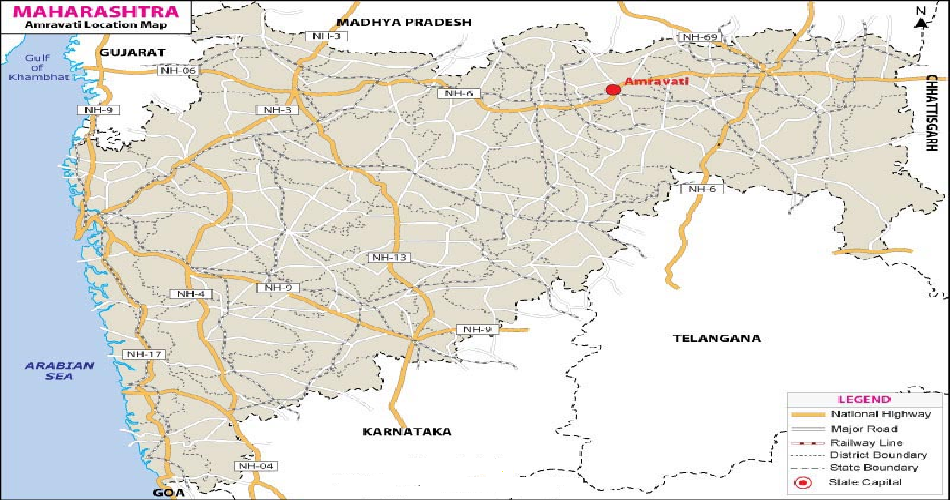
Amravati, often called Ambanagari or the Cultural Capital of Vidarbha, is a city with deep mythological connections, a rich history, and abundant natural beauty, especially with its proximity to the Satpura Range. Here is a detailed Tourist Map Guide of Amravati, Maharashtra (The Cultural Capital of Vidarbha):
Key Tourist Attractions: City & Nearby
The attractions are divided into three main categories: Religious/Historical (in the city), Natural/Wildlife (nearby), and Lakes/Gardens (in and near the city).
| Category | Place of Interest | Highlights / Significance | Distance from City Center (Approx.) |
| Religious/Historical | Shri Ambadevi Temple | Dedicated to Goddess Ambadevi (Amba). An ancient, revered temple in the heart of the city, believed to be the place where Lord Krishna eloped with Princess Rukmini. | City Center |
| Religious/Historical | Shri Ekvira Devi Temple | Dedicated to Goddess Ekvira Devi, an incarnation of Shakti. Built in 1660. Located near Ambadevi Temple. | City Center |
| Religious/Historical | Satidham Temple | Known for its idols of various Gods and Goddesses, including Radha-Krishna and Ram-Sita. Hosts a fair on Janmashtami. | City Center (Rallies Plot) |
| Religious/Historical | ISKCON Amravati | A modern spiritual center with beautiful architecture and a peaceful ambiance. | Within City Limits |
| Natural/Wildlife | Chikhaldara Hill Station | The only coffee-growing region in Maharashtra. Located in the Satpura Range, offering panoramic valley views and a cool climate. Entry point to Melghat. | ~85 km |
| Natural/Wildlife | Melghat Tiger Reserve | A prominent tiger habitat and one of India’s first nine tiger reserves. Famous for Bengal tigers, leopards, and diverse wildlife. Safari available. | ~70-80 km (Entry points like Semadoh) |
| Natural/Wildlife | Gavilgarh Fort | A historical 300-year-old fortified structure near Chikhaldara, offering panoramic views and a blend of history and nature. | ~95 km |
| Lakes & Parks | Wadali Talao (Lake) | A serene lake and natural attraction with boating facilities, a park, and a popular spot for picnics and bird watching. | ~5 km |
| Lakes & Parks | Chatri Talao (Lake) | Built in 1888, a historical reservoir nestled on a prime stretch of land, now a scenic spot for relaxation. | Near Dasturnagar Square |
| Lakes & Parks | Bamboo Garden | Features India’s largest collection of bamboo plants (134 species) and a cactus collection (300 species). A unique green space. | Within City Limits |
| Spiritual/Historical | Tukdoji Maharaj Samadhi | The samadhi (memorial) of the famous saint and social reformer, Rashtrasant Tukdoji Maharaj. | Mojhri (~40 km) |
City Architecture & Landmarks
Amravati was historically a walled city, and remnants of its old structure can still be seen:
- Jawahar Gate Clock Tower: An iconic structure and important landmark, often associated with the old city entrance.
- Amba Gate & Nagpuri Gate: Original historical city gates that once formed part of the city walls.
- Achalpur Fort: A historical fort located near Amravati, showcasing medieval architecture.
Best Time to Visit & Climate
| Season | Months | Temperature Range (Approx.) | Notes |
| Winter (Best Time) | October to February | $10^{\circ}\text{C}$ to $30^{\circ}\text{C}$ | Pleasant weather, ideal for sightseeing and wildlife safaris (Melghat). |
| Summer (Avoid Outdoor) | March to May | $25^{\circ}\text{C}$ to $45^{\circ}\text{C}$ | Extremely hot and dry. Outdoor activities are challenging. |
| Monsoon | June to September | $20^{\circ}\text{C}$ to $35^{\circ}\text{C}$ | Heavy rainfall. The landscape is lush green, but some attractions/roads may be affected. |
The ideal period to visit is from October to February.
Getting to Amravati
| Mode of Transport | Details | Key Stations/Terminals |
| By Air | The nearest major airport is Dr. Babasaheb Ambedkar International Airport, Nagpur (NAG). | Nagpur is approximately 152 km away. Taxis and buses are available from the airport. |
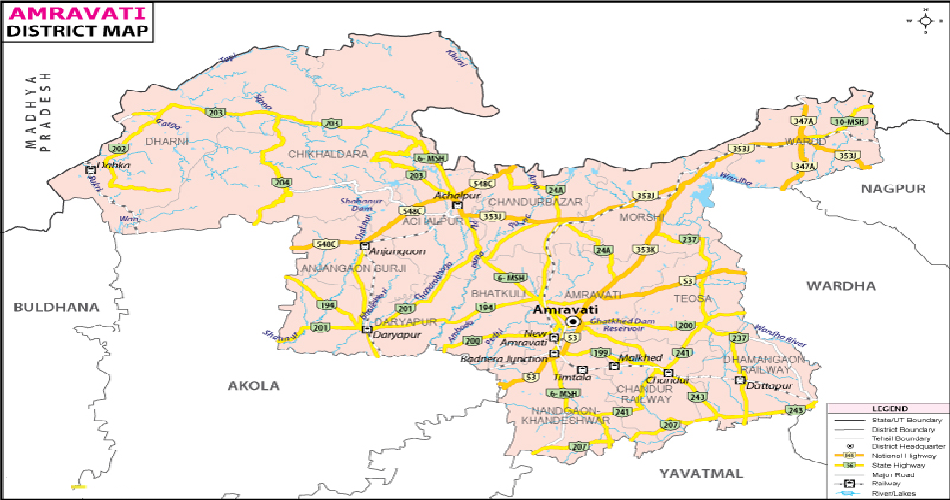
| By Rail | Amravati is well-connected to major cities. Badnera Junction (BD) is a significant railway station (about 10 km from the city) on the Howrah-Nagpur-Mumbai line. Amravati Railway Station (AMI) is a terminus in the city center. | Badnera Junction (BD), Amravati Railway Station (AMI), New Amravati (New Station). |
| By Road | Amravati is connected by National Highway (NH) 6 and other state highways. It has excellent bus connectivity to other cities in Maharashtra and neighboring states. | Amravati Bus Stand (MSRTC Bus Depot). |
Local Culture, Language, and Cuisine
- Official & Common Languages: Marathi (most widely spoken), Hindi, and English (especially in the tourism sector).
- Cuisine (Varhadi): Amravati is famous for its spicy Varhadi cuisine, which is distinct to the Vidarbha region.
- Must-Try Dishes: Puranpoli (sweet flatbread), Nyahaari, and various preparations of Vangi (Brinjal) and Bhindi (Okra) in the local style.
- Street Food Favorites: Sambharwadi, Gila Wada, Kachori, and local-style Pani Puri.
- Local Festival: Navratri is the most popular festival, celebrated with great pomp, including Garbha and Dandiya dances.
- Dance: Lavani is a historically important traditional folk dance of the region.
Travel Tips for Tourists
- Accommodation: The city offers a range of hotels from budget to mid-range. For a unique experience, consider forest camps near Melghat or resorts in Chikhaldara.
- Transportation within City: Auto-rickshaws, city buses, and app-based cabs/taxis are readily available. Negotiate auto-rickshaw fares or ask for meter use.
- Wildlife Visits: Book your Melghat Tiger Reserve safaris and accommodation in advance, especially during the peak season (October-February).
- Footwear: Wear comfortable footwear, especially when visiting temples or forts, or trekking in Chikhaldara.
- Water: Carry bottled water, particularly during day trips and summer months.